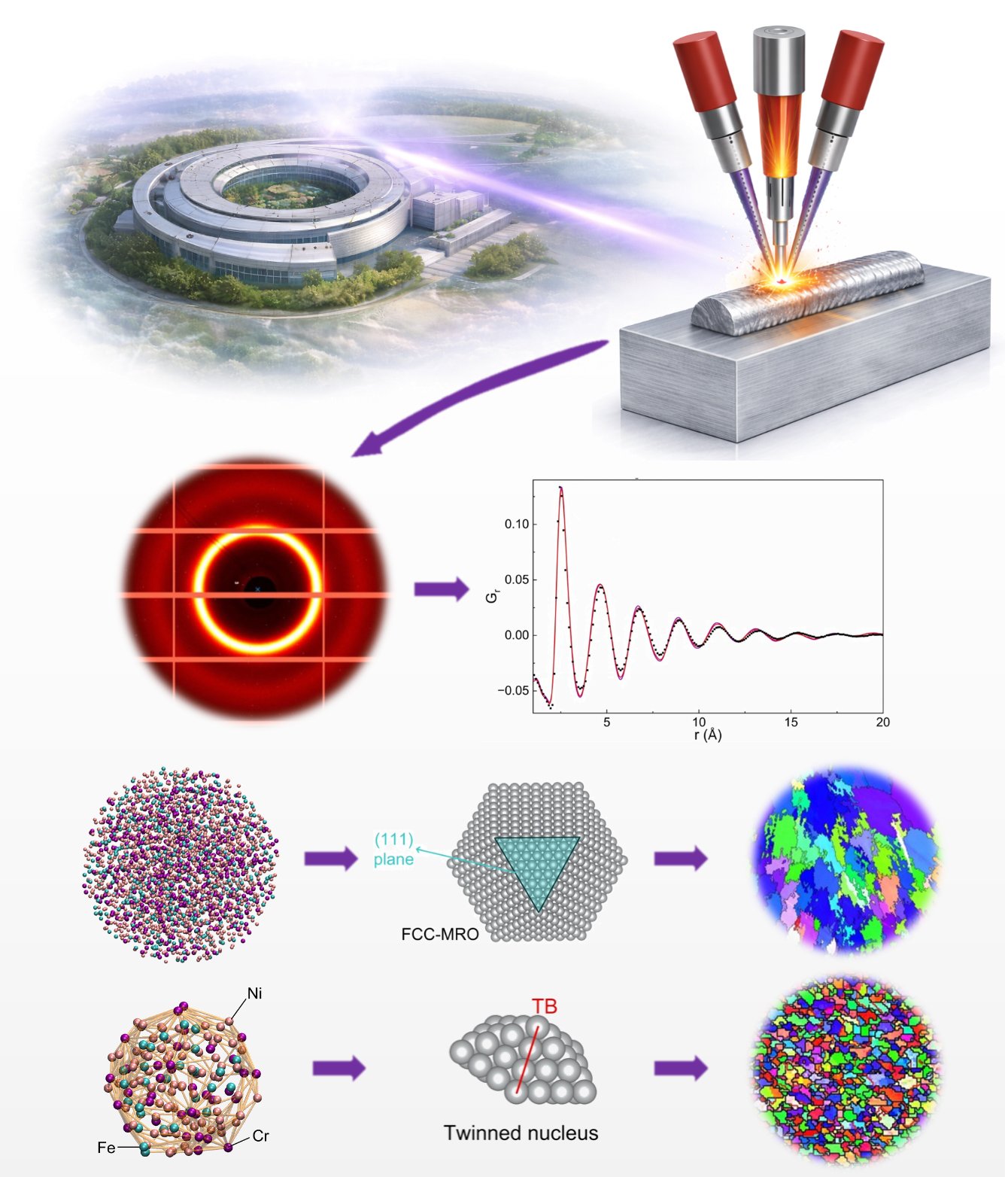
Northwestern University‘s associate professor of mechanical engineering Tao Sun and collaborators have published new research showing that the atomic-level arrangement of liquid metal, not just cooling rate and temperature gradient, governs how grain structures form during laser additive manufacturing. The findings, published in Nature Communications under the title “Operando X-ray scattering reveals ordering-mediated solidification in additive manufacturing,” give the industry a new, atomic-scale lever for predicting and controlling microstructure in printed metal parts. A Blind Spot in Metal Solidification Laser powder bed fusion and other laser additive manufacturing (LAM) processes can already produce advanced components for aerospace, medical, and energy applications, but the resulting microstructures in complex alloys have remained difficult to predict, a barrier to using LAM in the most safety-critical settings. Materials scientists have traditionally modeled solidification behavior around two variables: cooling rate and the temperature gradient at the liquid-solid interface. Sun’s team, working with co-authors including Lin… read more

Alex

Supermaterial applications company Lyten has been named the primary filament supplier for American aerospace and defense company Modovolo’s BFP platform, a transportable 3D printer built to manufacture aerospace, motorsports, and defense-grade parts outside traditional factory settings. The companies announced the partnership as a joint push toward a fully domestic additive manufacturing supply chain, from raw material to finished part. Modovolo’s BFP is a containerized, modular system designed to be deployed in remote or harsh environments without depending on outside supply chains, allowing large, complex components to be printed close to where they’re needed rather than shipped in from centralized factories. The platform has been tuned specifically to run on Lyten’s 3D Graphene-enhanced filament line, and PA1205 is now positioned as the default material across BFP installations. Why Modovolo Picked PA1205 Modovolo built the BFP out of necessity: the company couldn’t find a US-made 3D printer fast or affordable enough to produce… read more
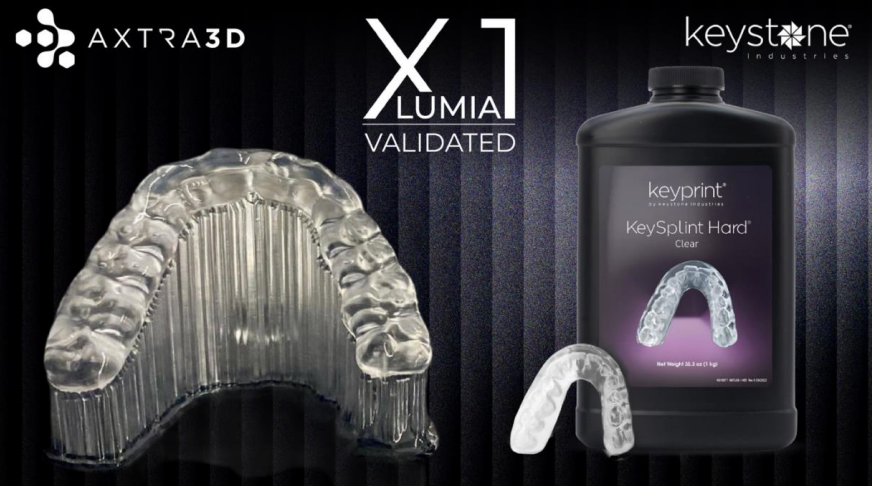
Axtra3D has validated KeySplint Hard Clear, a resin from dental partner Keystone Industries, for use on its Lumia X1 3D printer. The material becomes the second Keyprint resin validated for the platform, following KeyModel Ultra earlier in 2026, and adds a rigid, clear splint and retainer material to the growing Axtra.Solutions portfolio built around the Lumia X1. “We are pleased to announce the successful validation of KeySplint Hard Clear. This achievement marks another important milestone in our trusted and productive collaboration, reinforcing our shared commitment to delivering innovative, high quality solutions,” says Miguel Perez, Senior VP of Sales at Keystone. “We are proud to provide our mutual customers with a validated solution that consistently delivers outstanding results.” A Fit Built on Precision That milestone rests on a material built for one of dentistry’s more demanding use cases. KeySplint Hard Clear is intended for post-trauma tooth immobilization and orthodontic retainers, applications… read more


