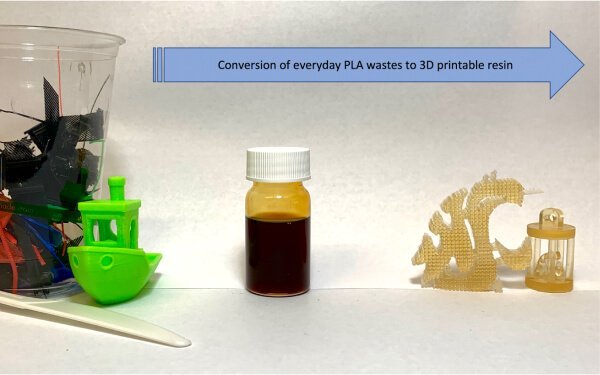
A team from Washington State University (WSU) has just received funding from the Cougar Cage to develop their process for converting waste PLA into brand new PLA resin for SLA and other photopolymer printers. Cougar Cage, for those curious, is the WSU equivalent of Shark Tank/Dragon’s Den, but for WSU staff, students and faculty. That is, it’s a contest where entrepreneurs pitch to investors to get their ideas off the ground in the style of the TV shows. One team has focused on the chemical recycling of PLA plastics, and for their efforts, they have made it through three rounds of the contest and been awarded with $50,000 of funding which will help the team develop the process to create new PLA resins from scrap. Scrap goes in > Resin comes out. (Image credit: WSU) The focus is to find alternative means of recycling PLA, because as we all know… read more

Alex
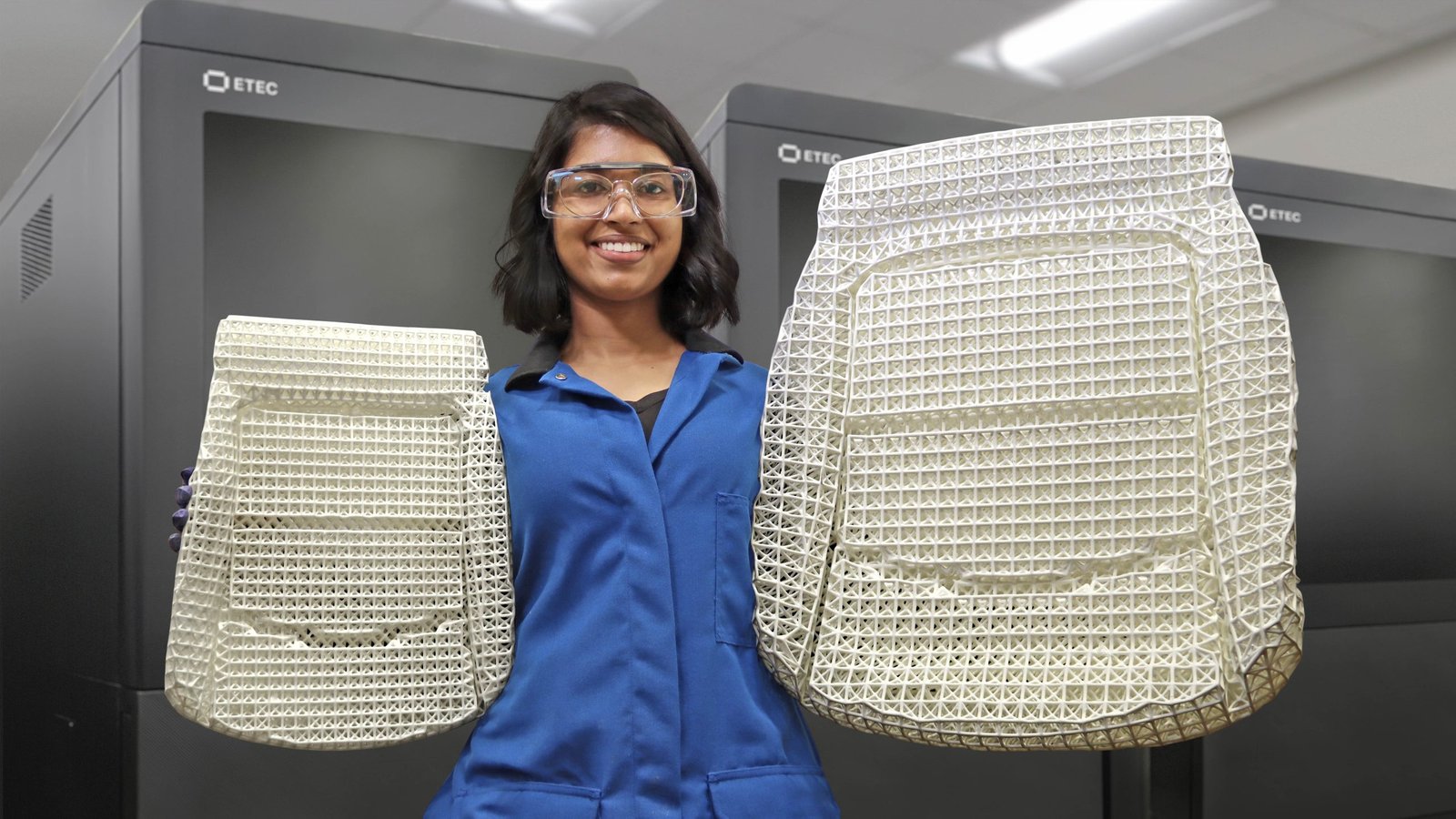
3D printer manufacturer Desktop Metal has debuted FreeFoam, a new 3D printable photopolymer resin family that contains heat-activated foaming agents. Invented by Texas-based materials specialist Adaptive3D, a Desktop Metal subsidiary acquired in 2021, FreeFoam can be programmed to expand anywhere between 2 to 7 times its original printed size without any tooling. The result is the production of tunable and durable closed cell foam parts, which are expected to see extensive use in sectors such as automotive, furniture, sporting goods, footwear, and healthcare. Initially available exclusively on the ETEC Xtreme 8K DLP 3D printer, FreeFoam will be showcased at Foam Expo North America in Michigan from June 28-30. The Expo will feature a 3D printed FreeFoam car seat developed in partnership with Camaco. “FreeFoam is one of the most exciting and commercially significant photopolymer solutions to come to market in the industrial printing space in years,” said Ric Fulop, founder… read more

A team of US researchers led by Virginia Tech has used 3D printing to create octopus-inspired adhesive suckers. Octopi, along with other members of the cephalopod class, rely on a combination of controllable adhesives and embedded sensing to stick to and manipulate objects underwater. Many of today’s synthetic adhesive-based manipulation systems tend to be human-operated without any sort of integrated sensing, which can result in relatively slow adhesion activation and release. The Virginia Tech research team has now developed its own nature-inspired nervous system capable of detecting objects and automatically switching on adhesion in a matter of milliseconds. Having implemented the 3D printing-enabled adhesive skin into a wearable glove, the scientists have created a novel approach to reliably manipulating objects in an underwater environment. The adhesion mechanism of the 3D printing-enabled sucker gloves. Image via Virginia Tech. Mother nature knows best To this day, effective and reversible adhesion to underwater… read more
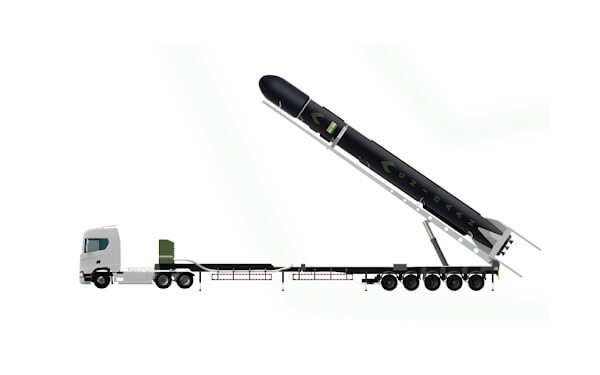
Indian aerospace engineering company Agnikul Cosmos has opened their first rocket printing factory at IIT Madras Research Park, Chennai. “Rocket Factory-1” is intended to churn out two rocket engines per week with their EOS printers and other machinery. This will allow the production of one complete launch vehicle per month. The factory contains all the tooling and hardware required to produce the whole engine in the same facility. Agnibaan rocket on Dhanush mobile launcher. (Image credit: Agnikul Cosmos) The 18m tall, 1.3m diameter, three-stage rocket is named Agnibaan, which means “arrow of fire”, and is capable of hoisting a 100 kg satellite into a 700 km orbit. According to the company website, the combustion section of the first stage will be 100% 3D printed. Looking at the image of their printed rocket motor below, it appears that this includes the injector plate, combustion chamber, cooling channels, and throat section. Printed… read more
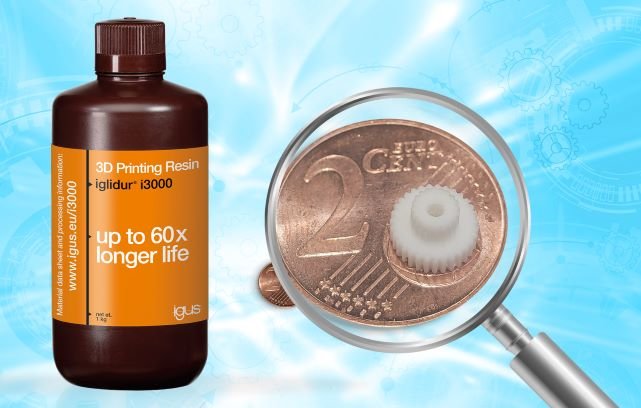
Multinational polymer manufacturer igus has released a new Digital Light Processing (DLP) 3D printing material that’s said to last up to 60 times longer than those of its competitors. Developed using igus’ proprietary ‘tribo-technology,’ iglide i3000 is tribologically-optimized in a way that enables it to produce accurate, highly wear-resistant parts. When DLP 3D printed, the firm says that its resin is ideal for creating tiny, detailed components like 0.2mm-tooth module gears, as well as any others that usually require filigree recesses or ultra-fine drill holes. “We were able to prove in laboratory tests that the service life of iglide i3000 is at least 30 times longer than 10 tested commercially 3D printing resins,’’ says Tom Krause, Head of Additive Manufacturing at igus. “In some applications, we even expect an increase in service life by a factor of 60.” A bottle of the new igus iglide i3000 DLP 3D printing material…. read more
- How technology reshapes the landscape of gambling today
- Mastering the Casino Experience An Advanced Guide to lucky lace slot Success
- Aprende estrategias básicas para principiantes en el casino con Fortune Tiger
- Les jeux de casino incontournables à découvrir absolument
- The Future of Casinos What to Expect from New Technologies at Zet Casino