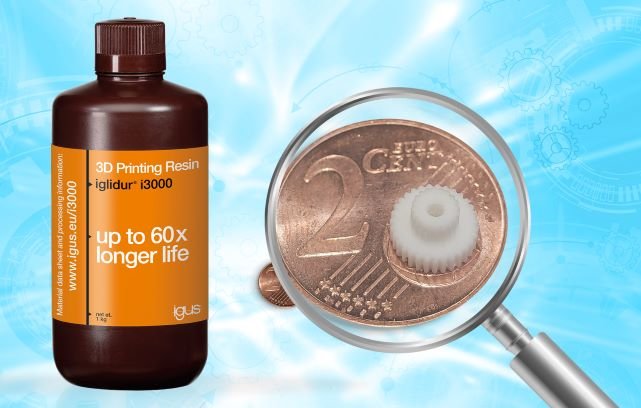
Multinational polymer manufacturer igus has released a new Digital Light Processing (DLP) 3D printing material that’s said to last up to 60 times longer than those of its competitors. Developed using igus’ proprietary ‘tribo-technology,’ iglide i3000 is tribologically-optimized in a way that enables it to produce accurate, highly wear-resistant parts. When DLP 3D printed, the firm says that its resin is ideal for creating tiny, detailed components like 0.2mm-tooth module gears, as well as any others that usually require filigree recesses or ultra-fine drill holes. “We were able to prove in laboratory tests that the service life of iglide i3000 is at least 30 times longer than 10 tested commercially 3D printing resins,’’ says Tom Krause, Head of Additive Manufacturing at igus. “In some applications, we even expect an increase in service life by a factor of 60.” A bottle of the new igus iglide i3000 DLP 3D printing material…. read more

Our Blog

The Additive Manufacturer Green Trade Association (AMGTA) has issued a report outlining a new method of passivating metal powder condensate waste from the 3D printing process. Developed by Sintavia, a service bureau for aerospace parts, and powder specialist KBM Advanced Materials, the new process involves adding the powder waste to a resin material to create a non-hazardous mixture. This allows the waste to be safely transported to recycling plants, where it can be reclaimed from the resin matrix and reused in additive manufacturing. According to Sherri Monroe, the AMGTA’s Executive Director, the latest report is a “must-read” for companies that operate with laser powder bed fusion (PBF) technologies. She adds, “Not only does this new process reduce transportation costs, but it is also reversible, meaning that metal recycling companies can have unsoiled access to the underlying powder once it is received—thus allowing for the potential to recycle waste material that… read more

New York-based fashion design company Simplifyber has just received 3.5 million USD in seed funding to continue development of their range of footwear and clothing. What is novel about the company is the material process they are using to create their fabrics. These fabrics are molded, not woven and stitched together, and they are molded from a mix of plant matter and other biodegradable materials. You can see the shoe in the image below. Upper molded over printed mold (Image credit: Simplifyber) First up, you will notice that the sole is clearly made with additive manufacturing, and this sole has been printed with the collaboration of HP, presumably on one of their MJF machines.But the real innovation lies in the shoe upper (the bit that covers the foot). This is the molded fabric, and it is produced with a means partly inspired by traditional paper making techniques. Like papermaking, the… read more

With more and more green initiatives popping up around the world, the market for materials making environmentally-sustainable claims seems to be exploding. This week alone, there’s been a whole slew of developments regarding biopolymer-based 3D printing filaments. Over in Canada, materials firms BOSK Bioproducts and Filaments.ca have launched the country’s first entirely bio-based, compostable line of 3D printing filaments. Named ‘Made with REGEN’, the PHA-based biopolymers contain no fossil fuel oils or chemical additives. Elsewhere, in London, the Otrivin Air Lab exhibition is showcasing how photobioreactors can be used to turn CO2 waste into 3D printing materials. Created by Claudia Pasquero and Marco Poletto of the ecoLogicStudio, the exhibition features a set of 12 photobioreactors capable of photosynthesis, which use CO2 to produce biomass that can be harvested to make 3D printable biopolymer filaments. In the research sphere, scientists at EPFL have developed their own biopolymer using non-edible plant material,… read more

A group of Italian researchers has developed a 3D printed artificial skin that could be used to improve the tactile sensing capabilities of robots. Researchers from Scuola Superiore Sant’Anna, Ca’ Foscari University of Venice, and the Sapienza University of Rome created the 3D printed skin which successfully mimicked the function of Ruffini receptors, a type of cell located on subcutaneous human skin tissue that detect stretching, vibrations, warmth, and pressure. Once attached to a robot and combined with a deep learning algorithm based on a multi-layered convolutional neural network (CNN), the skin can estimate the force and point at which the robot comes into contact with an object, potentially enabling safer human-robot cooperation in the future. The 3D printed artificial skin. Image via Nature Machine Intelligence. 3D printing artificial skin 3D bioprinted skin models and grafts have received increasing interest and development in recent years due to their potential uses… read more
- How technology reshapes the landscape of gambling today
- Mastering the Casino Experience An Advanced Guide to lucky lace slot Success
- Aprende estrategias básicas para principiantes en el casino con Fortune Tiger
- Les jeux de casino incontournables à découvrir absolument
- The Future of Casinos What to Expect from New Technologies at Zet Casino


