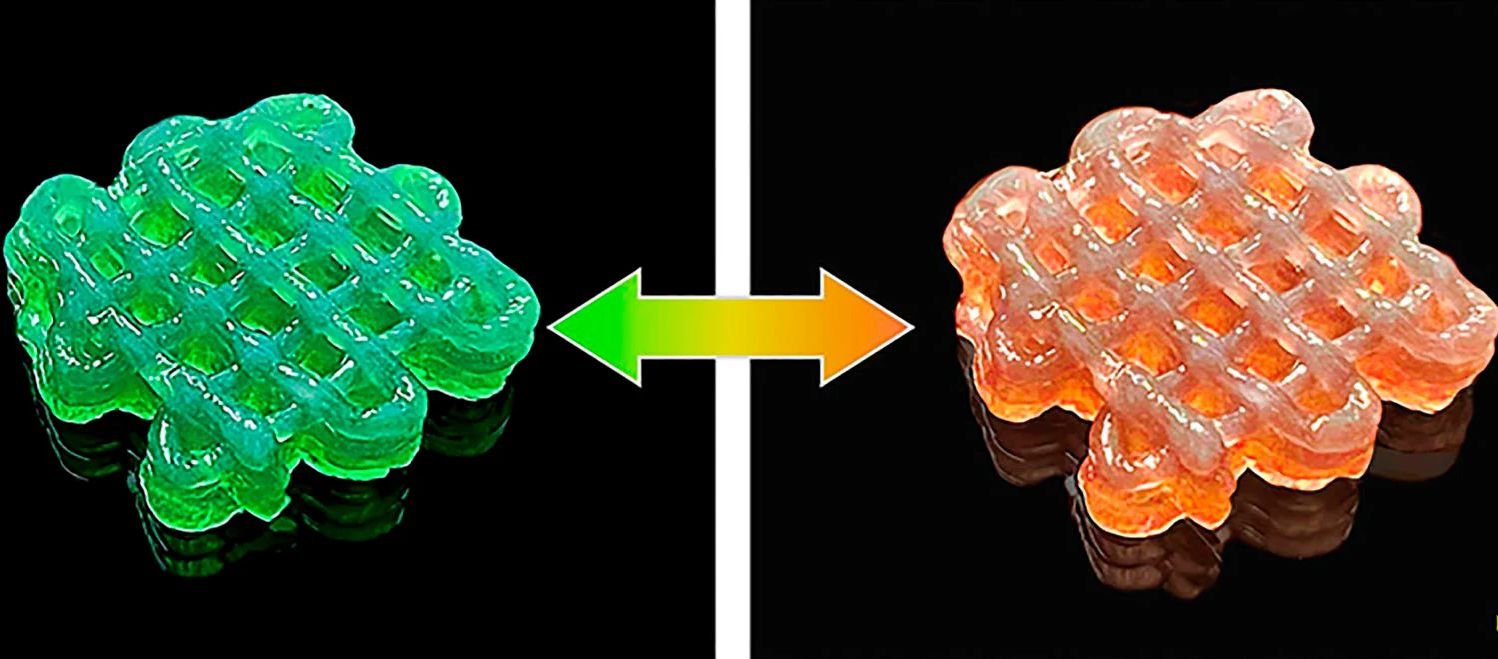
A group of China-based researchers have developed a new way of adding color to 3D printed parts that’s said to result in much safer products than conventional dyeing or pigmentation. The scientists’ approach revolves around a biocompatible ink they’ve developed, which yields parts capable of changing appearance through ‘structural coloration,’ in response to heat or light stimuli. Using their material, the team say it could be possible to produce everything from wearable bio-sensors to more child-safe toys. “We believe that [our] cholesteric liquid crystal ink can shed light on next-generation environmentally friendly 3D photonic printing,” the team explain in their paper, published in this week’s Proceedings Of The National Academy Of Sciences journal. “The ink maintains a cholesteric liquid crystalline state that gives rise to the structural color.” A 3D printed part changing color under different thermal conditions. Image via the South China Morning post. Overcoming the toxicity of dyeing… read more

3D Printing Materials

America’s most prominent 3D printing event, RAPID + TCT, kicked off this week in Detroit with more than 400 exhibitors showcasing their product and service offerings on the trade show floor. 3D Printing Industry is reporting live from the event all week, and you can take a first glance at all the RAPID + TCT 2022 news here. This round-up looks at new materials launched during the event so far, featuring updates from Formlabs, Uniformity Labs, Jabil, Trumpf, Morf3D, 6K Additive, and more. A selection of parts 3D printed with Formlabs’ PU Rigid 650 Resin. Photo via Formlabs. Formlabs announces new PU resins Kickstarting the material launches at RAPID + TCT 2022 is resin-based 3D printer manufacturer Formlabs, which has added two new polyurethane (PU) resins to its engineering resin portfolio. Designed for the production of rigid and durable parts, PU Rigid 650 Resin and PU Rigid 1000 Resin are… read more
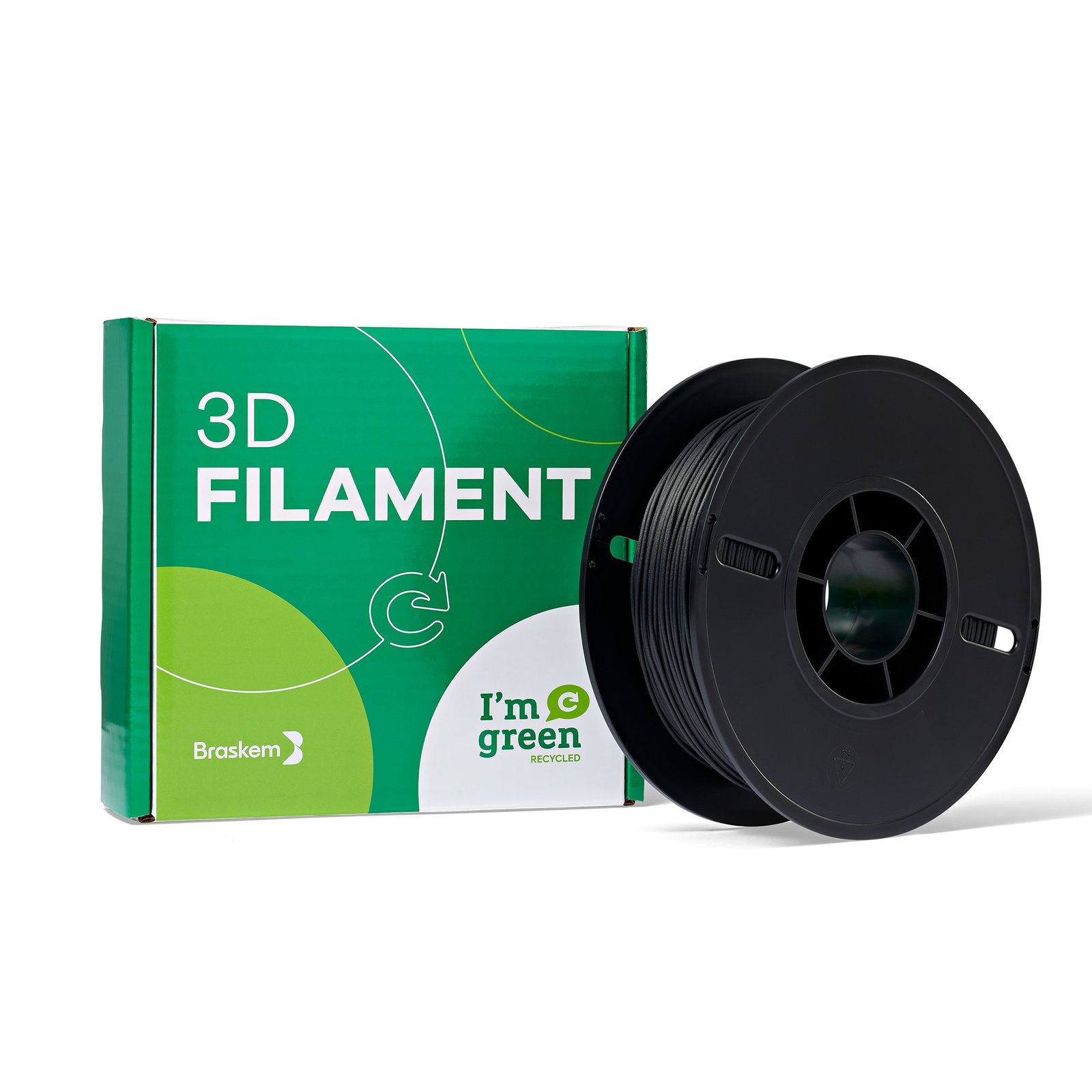
Brazilian petrochemical firm Braskem has released its first line of sustainable 3D printing filaments. Made up of three filaments produced from bio-based ethylene vinyl acetate (EVA), recycled polyethylene (PE) and polypropylene (PP), the new range will be showcased at the upcoming RAPID + TCT trade show in Detroit. “Braskem has a longstanding history of innovating and producing more sustainable bio-based polymer 3D printing filaments reaffirms our commitment to a more circular, carbon neutral future,” said Jason Vagnozzi, Braskem’s Global Commercial Director of Additive Manufacturing. “We couldn’t be more excited to present these newest additions to our 3D printing product portfolio at the RAPID + TCT 2022 conference as our clients seek more sustainability solutions for the future.” Recycled polyolefin filament with carbon fiber. Image via Braskem. Braskem’s growing AM materials portfolio Since its founding in 2002, Braskem has been developing plastics for new applications, particularly within the aerospace sector. The… read more

Material manufacturer Epson Atmix Co (Atmix), subsidiary of the multinational Japanese electronics firm Seiko Epson Corporation (Epson), has unveiled plans to establish a new metal powder factory. Set to open by 2025, the complex is expected to feature metal recycling facilities, that enable scrap materials to be turned into usable alloy powders with 3D printing potential. Atmix’s announcement closely follows Epson’s own revelation that it plans to finally enter the additive manufacturing sector with a new industrial extrusion 3D printer, some eight years after first signaling its intention to do so. Atmix’s Kita-Inter Plant. Image via Epson. Epson finally segues into 3D printing Although Epson is primarily known for its 2D printing exploits, it has made no secret of its aspiration to expand into the 3D printing industry. As long ago as 2014, the firm’s President Minoru Usui talked openly of wanting to move into 3D printing, not just with… read more

In the second edition of 3D Printing Industry’s series on Artificial Intelligence (AI) and 3D printing, interviewees tell us how the technology is helping step up the process of identifying, optimizing and qualifying new additive manufacturing materials. As engineers that work in the industry will no doubt be aware, before 3D printing with any novel material, it’s necessary to ‘qualify’ it first. Traditionally, this has meant identifying a link between entered parameters for processing a given feedstock, and the properties of the parts it produces, in a way that provides later users with assurances on quality. However, qualification can be lengthy and laborious, and in the past, the National Institute of Standards and Technology (NIST) has criticized its “lack of repeatable process outcomes,” as an “impediment to [3D printing’s] widespread implementation.” One of those now seeking to accelerate the process is Intellegens, which has developed its own AI toolset that’s… read more
- How technology reshapes the landscape of gambling today
- Mastering the Casino Experience An Advanced Guide to lucky lace slot Success
- Aprende estrategias básicas para principiantes en el casino con Fortune Tiger
- Les jeux de casino incontournables à découvrir absolument
- The Future of Casinos What to Expect from New Technologies at Zet Casino


