

Northwestern University‘s associate professor of mechanical engineering Tao Sun and collaborators have published new research showing that the atomic-level arrangement of liquid metal, not just cooling rate and temperature gradient, governs how grain structures form during laser additive manufacturing.
The findings, published in Nature Communications under the title “Operando X-ray scattering reveals ordering-mediated solidification in additive manufacturing,” give the industry a new, atomic-scale lever for predicting and controlling microstructure in printed metal parts.
A Blind Spot in Metal Solidification
Laser powder bed fusion and other laser additive manufacturing (LAM) processes can already produce advanced components for aerospace, medical, and energy applications, but the resulting microstructures in complex alloys have remained difficult to predict, a barrier to using LAM in the most safety-critical settings.
Materials scientists have traditionally modeled solidification behavior around two variables: cooling rate and the temperature gradient at the liquid-solid interface. Sun’s team, working with co-authors including Lin Gao, Kyle Mumm, and Zhongshu Ren, set out to test a factor that classical models leave out entirely: the structural arrangement of atoms inside the molten metal itself, before it ever begins to solidify.
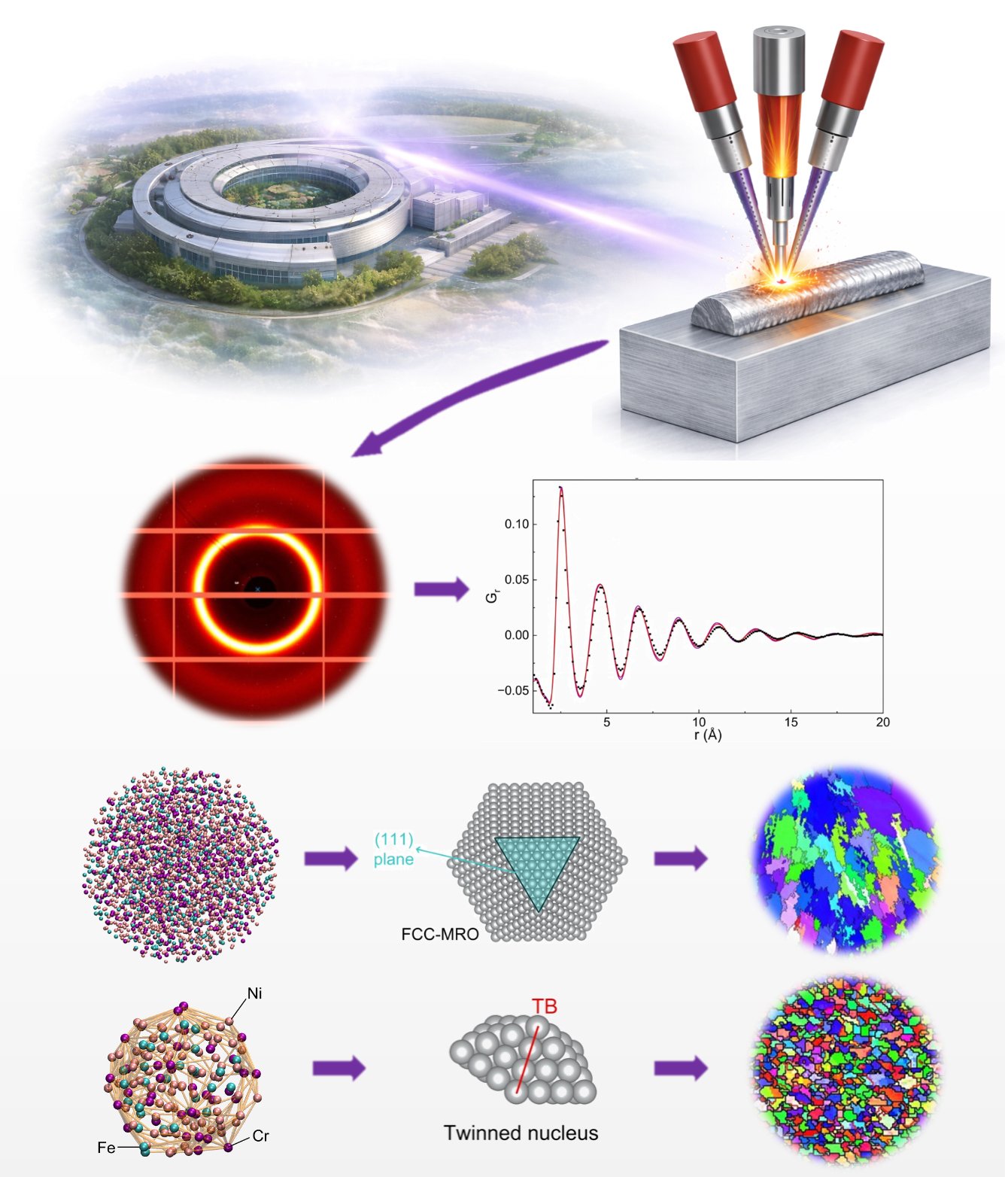
Using operando synchrotron X-ray total scattering combined with rapid pair distribution function (PDF) analysis, the team captured melt pool behavior in Inconel 718 and other alloys as it happened, rather than reconstructing it after the fact from a finished, solidified part. The measurements were carried out 1-ID-E beamline at Argonne National Laboratory’s Advanced Photon Source (APS), a full-field X-ray imaging setup capable of resolving these transient atomic-scale dynamics in real time.

What the X-Rays Revealed
The scattering data showed that molten metal is not the uniform, structureless liquid it is often assumed to be. Instead, it contains organized atomic clusters exhibiting short- and medium-range order, including icosahedral cluster arrangements. As solidification proceeds, some of these clusters are selectively consumed and reorganize into small, twinned atomic structures rather than forming large, orderly crystals. That pathway produces unusually fine grains and distinctive internal boundaries, and the team links it directly to abnormal columnar-to-equiaxed transition (CET), a phenomenon long observed in printed metals but not previously traced to a specific atomic-scale mechanism.
“By revealing why unusual grain structures form and how they can be controlled, this research helps remove a key barrier to using metal 3D printing in everyday technologies,” Sun said. “Understanding how metals solidify at the atomic level allows engineers to design parts that are lighter, tougher, and longer-lasting, while reducing waste, energy consumption, trial-and-error testing, and costly failures. More broadly, our study shows how cutting-edge science can potentially translate into practical improvements in manufacturing.”
From Observation to Real-Time Control
The immediate contribution is diagnostic: direct evidence that liquid atomic structure shapes solidification pathway, observed as it happens inside an active melt pool rather than inferred from the finished microstructure. But Sun’s group frames the result as a foundation for two follow-on efforts. The first is improving predictive models by building them around measured liquid atomic structure rather than assumptions about a featureless melt. The second is longer-term: developing real-time monitoring and feedback control systems that could adjust print parameters mid-process to steer grain formation as it occurs.
“If realized, we can then build parts with pre-designed performance reliably,” Sun said.
On the process-control front, Sun’s group is now aiming to fine-tune how metals shift between coarse columnar grains and finer, uniformly distributed ones, working through both alloy composition and print parameters as the levers for that shift. That effort runs alongside a parallel push on the data side, where the team wants to stop relying on models that presume which atomic arrangements exist in the melt and instead reconstruct the actual atomic structure straight from the X-ray measurements themselves.
Together, these two threads, sharper structural analysis and tighter solidification control, define where the research heads next.

Limits and Challenges
The research has limits. Even with the new mechanism nailed down, the fitting method has built-in uncertainty, small-box PDF fitting requires preselecting structural motifs, which the authors say gets riskier in operando data where peak fingerprints are less distinct. Their molecular dynamics simulations were also narrowed to just three principal elements (Ni, Fe, Cr), since no interatomic potential exists for the full alloy, and rare fivefold-twinned grain clusters showed up in the data that their proposed two-grain twinning model can’t fully explain.
The findings are also bounded by scope: all measurements came from single-track deposits, and while a separate bulk sample confirmed the same transition occurs across layers, the bulk-sample regions were slightly smaller, which the authors attribute to differences in melt pool geometry and thermal history between single-track and bulk builds. The role of alloy chemistry stays unresolved too, their data didn’t support niobium as the driver, as prior work suggested, but they can’t rule out subtler compositional effects their measurements weren’t able to isolate.
Funding for the work came from the National Science Foundation under award DMR-2427686, with additional support for Ren’s contribution provided through the 18-ID (FXI) beamline at Brookhaven National Laboratory’s NSLS-II.
Chasing Grain Control Beyond the G-R Model
Sun’s finding pushes at a real gap in metal AM: engineers have long relied on cooling rate and temperature gradient, the classical “G-R” framework, to predict grain formation, treating molten metal as an undifferentiated liquid. By showing that atomic-scale ordering inside the melt pool itself steers columnar versus equiaxed growth, the study reframes microstructure as rooted in liquid-state physics, not just process parameters, opening a path toward tuning alloy chemistry or laser conditions to shape grain structure directly.
The broader field has been circling this same target from other angles. Researchers at Fraunhofer-Gesellschaft and RMIT University, through the recently concluded UltraGRAIN project, worked to tailor grain structure during laser-based directed energy deposition builds rather than accept whatever the process naturally produces, following RMIT’s earlier demonstration that high-intensity ultrasound could refine columnar grains into fine equiaxed ones.
Separately, a University of Manchester study published in June 2026 found that just a few degrees of temperature shift at the nozzle in molten metal deposition could reshape internal microstructure and defect formation in aluminum parts, reinforcing how sensitive grain outcomes are to conditions most process maps ignore.
Together, these efforts point toward the same conclusion Sun’s team arrived at from a different instrument: geometry in metal AM is largely solved, but microstructure control still depends on physics the field is only beginning to measure directly.
3D Printing Industry is inviting speakers for its 2026 Additive Manufacturing Applications (AMA) series, covering Energy, Healthcare, Automotive and Mobility, Aerospace, Space and Defense, and Software. Each online event focuses on real production deployments, qualification, and supply chain integration. Practitioners interested in contributing can complete the call for speakers form here.
To stay up to date with the latest 3D printing news, don’t forget to subscribe to the 3D Printing Industry newsletter or follow us on LinkedIn.
Explore the full Future of 3D Printing and Executive Survey series from 3D Printing Industry, featuring perspectives from CEOs, engineers, and industry leaders on the industrialization of additive manufacturing, 3D printing industry trends 2026, qualification, supply chains, and additive manufacturing industry analysis.
Featured image shows Operando X-ray pair distribution function measurement reveals the atomic structure of the melt pool and ordering-mediated solidification in laser additive manufacturing. Image via Northwestern University.
Source link
2026-07-31 12:21:00


